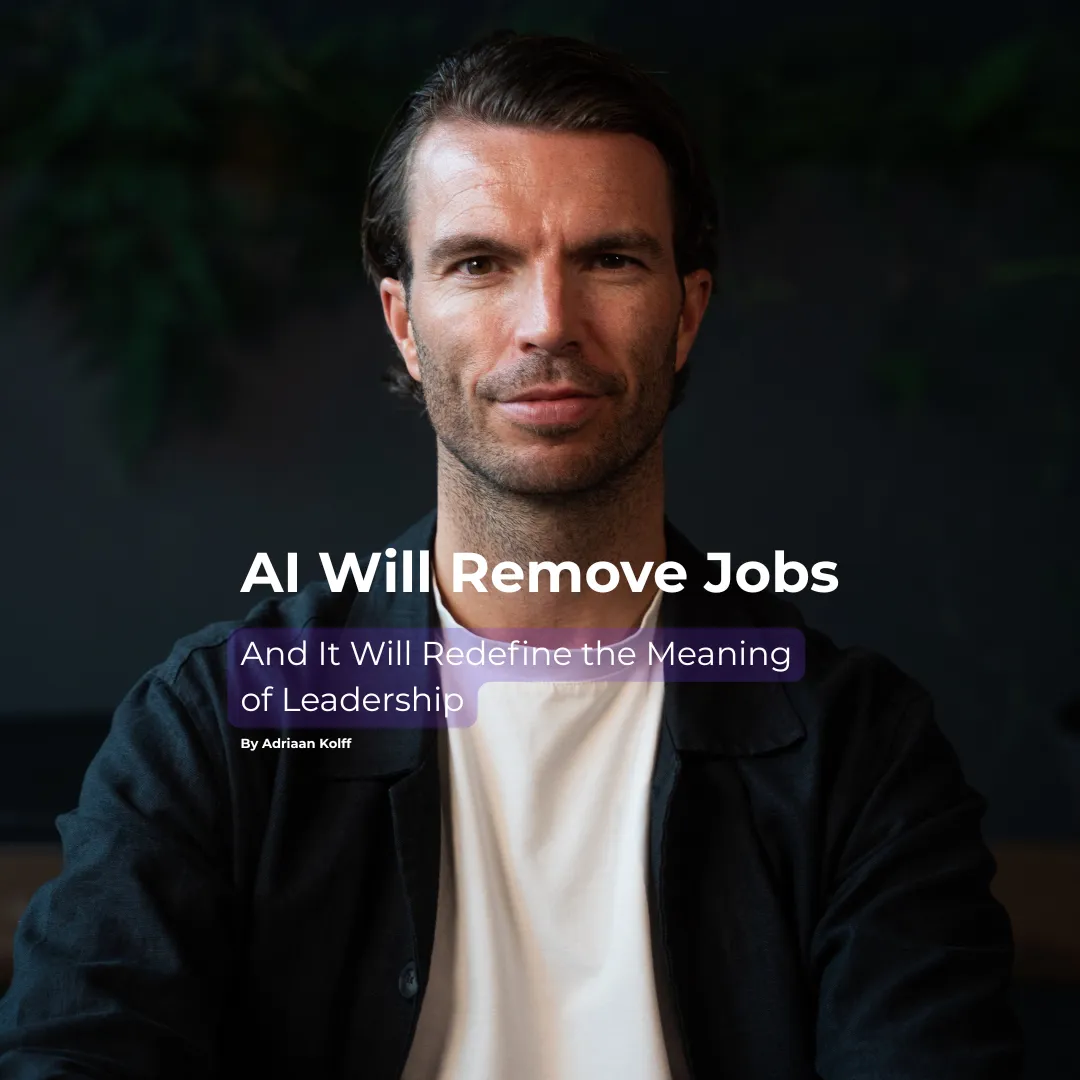
AI Will Remove Jobs, And It Will Redefine the Meaning of Leadership
Few technological shifts have generated as much anticipation and unease as the rapid rise of artificial intelligence in the workplace. While previous waves of automation reshaped industries gradually, AI is advancing at a pace that feels immediate and, for many, deeply personal. The concern is no longer abstract. It sits at the center of boardroom discussions, leadership offsites, and everyday conversations between managers and their teams.
There is no value in denying the reality that AI will eliminate jobs. Large parts of administrative, operational, and repetitive work are already being automated, and this trend will only accelerate. In functions such as recruiting, sourcing, and talent operations, the number of roles required to manage processes manually will decline, and entire categories of work will be fundamentally redefined. This is not a future scenario. It is already underway.
What is far less discussed is what this shift means for leadership, and why the human dimension of work becomes more critical, not less, as technology advances. As machines assume responsibility for execution and efficiency, the burden of meaning, direction, and connection moves decisively to leaders. Organizations that fail to recognize this risk solving the wrong problem, focusing on technological optimization while neglecting the human infrastructure that holds companies together.
Throughout my career working at the intersection of talent, technology, and global organizations, I have seen several cycles of automation promise radical efficiency gains. Each time, the pattern has been consistent. Technology reduces friction, increases speed, and removes certain forms of labor. At the same time, it exposes weaknesses in leadership that were previously masked by scale, hierarchy, or complexity. When processes become automated and teams become leaner, the quality of leadership is no longer diluted. It becomes immediately visible.
People do not stop wanting to work with other people simply because software becomes more capable. They still want to feel part of something larger than themselves, to understand how their work contributes to a broader direction, and to trust that decisions are being made with intention and care. AI can optimize workflows, but it cannot create belonging, nor can it provide the sense of purpose that sustains engagement over time.
As organizations adopt AI and reduce headcount in certain areas, the expectations placed on those who remain increase significantly. Fewer roles mean that each individual carries greater responsibility, operates with higher autonomy, and represents the organization more directly. This shift places unprecedented demands on leadership, particularly in environments where teams are distributed, hybrid, or constantly evolving.
In such contexts, leadership can no longer rely on formal authority, process compliance, or carefully crafted internal messaging. What matters instead is the ability to communicate clearly and consistently, to translate strategic intent into practical meaning for people at every level of the organization, and to create trust through presence rather than position. Leaders must be able to explain not only what is changing, but why it matters and how individuals fit into the future that is being built.
This is where many organizations are currently falling short. There is a growing temptation to treat communication itself as something that can be automated, whether through AI generated updates, standardized feedback systems, or digital interfaces that replace direct human interaction. While such tools can support efficiency, they become problematic when they are used as substitutes for leadership rather than enablers of it. Human connection is not an operational task that can be outsourced. It is a responsibility that sits squarely with those who lead.
The most effective leaders I observe today are not withdrawing as technology advances. On the contrary, they are becoming more present. They spend more time listening, more time explaining decisions, and more time reinforcing a simple and coherent narrative about where the organization is going. In an environment defined by constant change, repetition and clarity are not signs of oversimplification, but of discipline.
For CHROs and senior people leaders, this shift has profound implications. The role of HR is moving beyond process ownership and policy enforcement toward becoming the steward of leadership quality within the organization. Developing managers who can navigate uncertainty, communicate without ambiguity, and maintain trust during periods of transition is now a core strategic priority. This work cannot be delegated to platforms or vendors, nor can it be postponed until after technological transformation has taken place. In many cases, it is the prerequisite for that transformation to succeed.
At the same time, it is important to recognize that while certain roles will disappear, growth itself does not. History shows that periods of automation often coincide with the creation of new forms of work, new capabilities, and new organizational models. The challenge lies in managing this transition effectively, particularly in a business environment where demand fluctuates rapidly and traditional hiring models struggle to keep pace.
Organizations today need far greater flexibility in how they build and adapt their teams, without sacrificing the human judgment and connection that remain essential in areas such as hiring. This belief sits at the core of why Matchr was built. As AI reshapes recruiting and talent acquisition, some tasks will inevitably disappear, but the need for thoughtful, human centered decision making will remain. Matchr enables companies to scale their recruiting capacity in line with changing business needs, while preserving the personal engagement that candidates and hiring managers expect.
This is not about resisting technological progress, nor about protecting outdated roles. It is about recognizing that sustainable growth depends on balance. AI excels at processing information and executing tasks at scale. Humans excel at understanding context, building relationships, and making nuanced decisions in uncertain environments. Organizations that succeed will be those that design systems allowing each to do what it does best.
Looking ahead, the most important question leaders should be asking is not how quickly they can deploy AI across their organization, but whether their leadership culture is strong enough to support the changes that AI inevitably brings. Are leaders equipped to guide people through uncertainty, to articulate a compelling direction, and to remain visible and accessible as structures evolve?
AI will remove jobs, and that reality must be faced with honesty rather than denial. At the same time, it is redefining what effective leadership looks like in a modern organization. Companies that invest in clarity, connection, and human centered leadership will not only navigate this transition more successfully, but will also set the standard for what meaningful work looks like.
Adriaan Kolff, CEO Matchr