CPO's and Head of Recruitments Must Understand Finance, or Someone Else Will Set Their Agenda
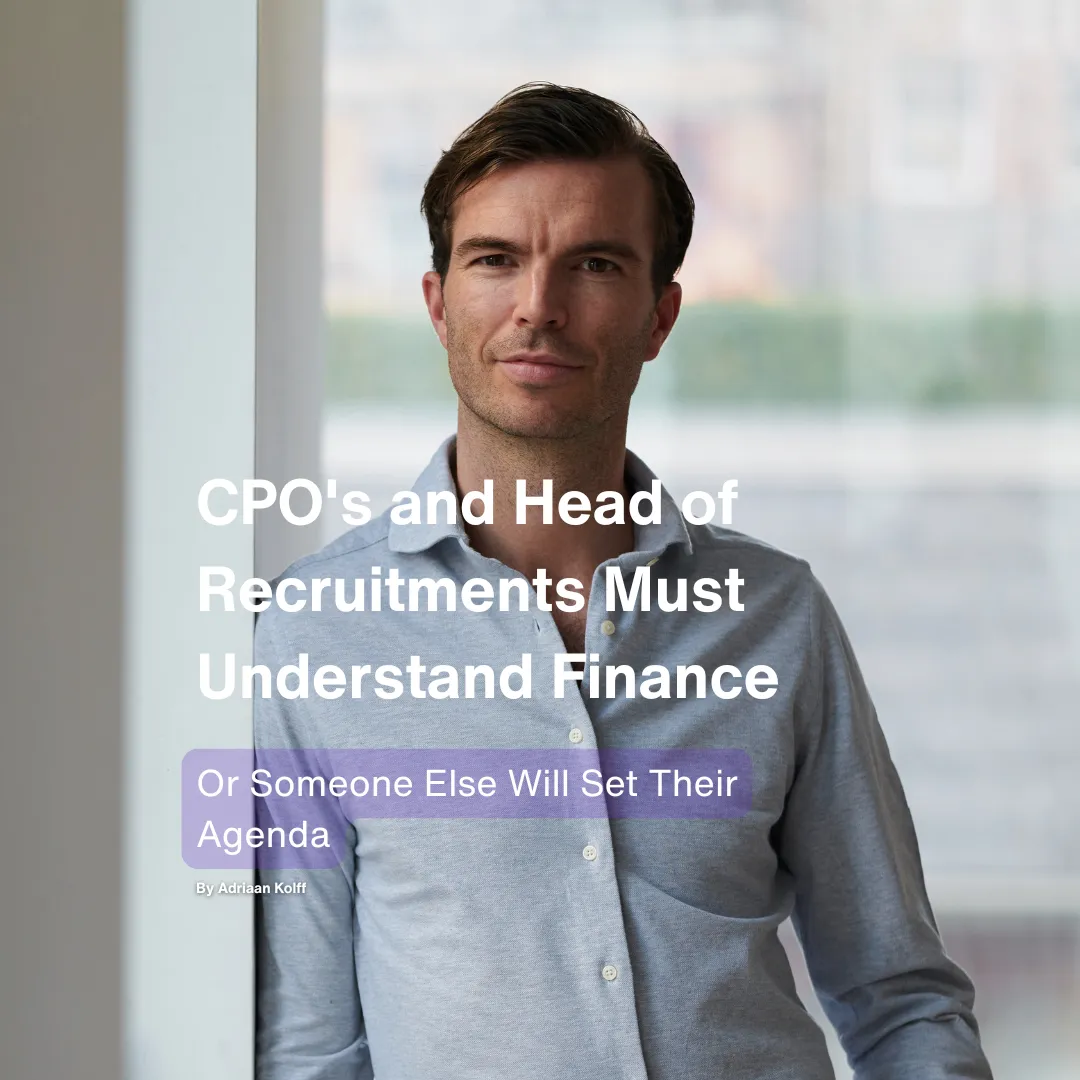
CPO's and Head of Recruitments Must Understand Finance, or Someone Else Will Set Their Agenda
For a long time, the influence of the Chief Human Resources Officer was rooted in stewardship rather than strategy. The role was designed to safeguard culture, manage complexity, and ensure that the organization functioned smoothly as it grew. While these responsibilities remain essential, they are no longer sufficient in an environment where financial scrutiny is constant and every function is expected to demonstrate its contribution to value creation.
The reality inside executive teams today is that decisions are shaped by those who can connect their domain directly to how the company makes money, how the company is valued, and how risk is managed. The language of business.
Leaders who speak that language influence priorities. Those who do not often find themselves reacting to decisions rather than shaping them. For CHRO’s, Chief People Officers and Recruitment Leaders this shift has profound implications.
People related decisions sit at the center of the financial engine of most organizations. Headcount is typically the largest line item on the P&L. Hiring speed influences how quickly revenue can be realized. Attrition affects margin, continuity, and execution risk. Leadership quality shapes decision making, productivity, and long term resilience. Yet despite this, people topics are still frequently discussed in isolation from financial outcomes.
This disconnect rarely stems from a lack of intelligence or ambition. Many CHRO’s that I have met are deeply experienced operators with a sophisticated understanding of talent, organization design, and leadership development. What is often missing is fluency in the financial mechanics that govern how the business is evaluated and how tradeoffs are made at the top of the organization.
In boardrooms and executive meetings, the language of influence is finance. Revenue, margin, cash flow, risk, and enterprise value are the reference points through which priorities are assessed.
When people initiatives are framed primarily in terms of engagement, culture, or long term capability, they can struggle to compete for attention, particularly in moments of economic pressure. Not because they are unimportant, but because their impact is not expressed in terms that align with how decisions are made.
The consequence is subtle but significant. When market conditions tighten or growth expectations shift, hiring decisions are made quickly, often without a granular understanding of which roles directly pull revenue forward and which protect operational stability. Investments in leadership or capability building are postponed because their return is not articulated in financial terms. Organizational changes are driven by cost targets rather than strategic intent.
In these moments, the agenda is not neutral. If the CPO cannot clearly explain how people decisions affect EBITDA, net debt, or valuation, those decisions will still be taken, but primarily through the lens of finance leaders who may not have full visibility into human capital dynamics. The result is not necessarily wrong, but it is incomplete.
The people leader who understands finance does not need to become a CFO. What is required is a working, practical understanding of how value is created in the business and how the people function contributes to it. This includes knowing, line by line, how workforce decisions show up in the P&L, how changes in hiring velocity affect revenue timing, and how leadership quality influences risk and execution over time.
When people leaders can engage at this level, conversations change. Hiring is no longer discussed as a cost to be controlled, but as an investment with a measurable return. Retention becomes a margin conversation. Leadership development becomes a risk mitigation strategy. Culture is understood not as an abstract ideal, but as a factor that influences how effectively capital is deployed.
This fluency also changes the relationship between the CHRO, the CEO, and the CFO. Rather than defending people initiatives after priorities have been set, the CHRO becomes a partner in shaping those priorities from the outset. Tradeoffs can be discussed openly, with a shared understanding of both financial and human implications. This is where real influence emerges.
Increasingly, boards expect this level of integration as well. Discussions around succession, organizational capability, and leadership depth are now directly linked to enterprise value and long term sustainability. The CHRO or people leader who can bridge these conversations gains credibility not only as a people leader, but as a business leader.
This shift requires a reframing of how people topics are communicated internally. Narrative remains important, but narrative alone is no longer enough. The most effective CHRO’s combine a clear story about the organization with data and financial logic that supports it. They understand which metrics matter, which assumptions hold, and how to explain uncertainty without losing trust.
This perspective also informs how external partners are evaluated. In a world where cost discipline and flexibility matter, unpredictability becomes a liability. This is one of the reasons Matchr was designed as a single, transparent line item in the P&L. Companies can scale our support up when accelerating revenue requires faster team ramp up, and scale it down quickly when priorities shift toward cost control.
This model creates a direct connection between the people function and financial outcomes. It allows hiring capacity to become a lever rather than a fixed cost, and it enables CPO’s and CFOs to make decisions together using the same language and assumptions. The goal is not to reduce people decisions to numbers, but to ensure that they are taken seriously within the financial reality of the business.
Ultimately, this is a shift in what it means to be a People Leader. The role is evolving from guardian of people processes to architect of human capital value. That evolution does not diminish the importance of empathy, culture, or trust. It strengthens them by anchoring them in the realities that govern how organizations survive and grow.
The question facing people leaders today is not whether finance should influence HR, but whether HR can afford not to influence finance. If the CHRO cannot articulate how people decisions affect revenue, margin, risk, and valuation, that agenda will be set elsewhere. Those who can make this connection will not only protect their influence, but will help their organizations make better, more balanced decisions in an increasingly demanding environment.
Adriaan Kolff, CEO Matchr